
Last updated November 14, 2026
 Wrought iron
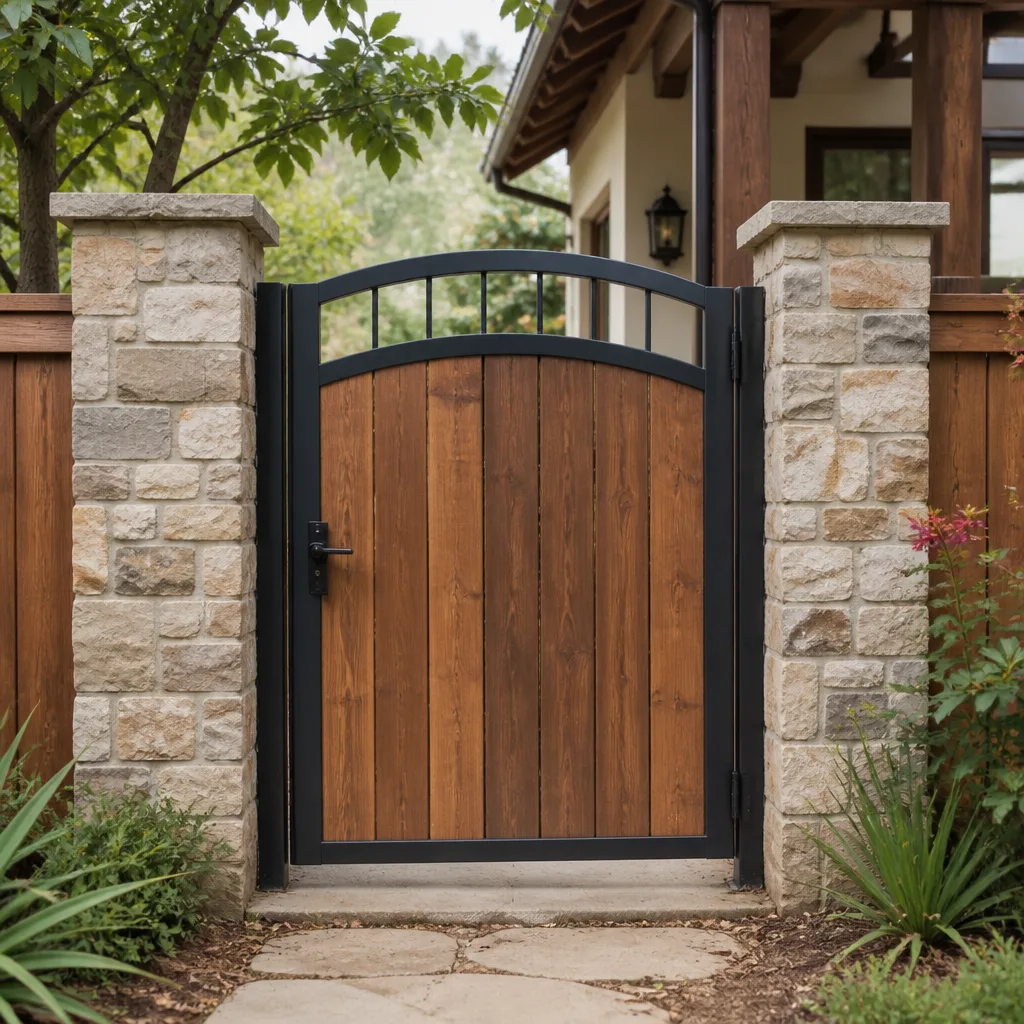 Wood & steel frame
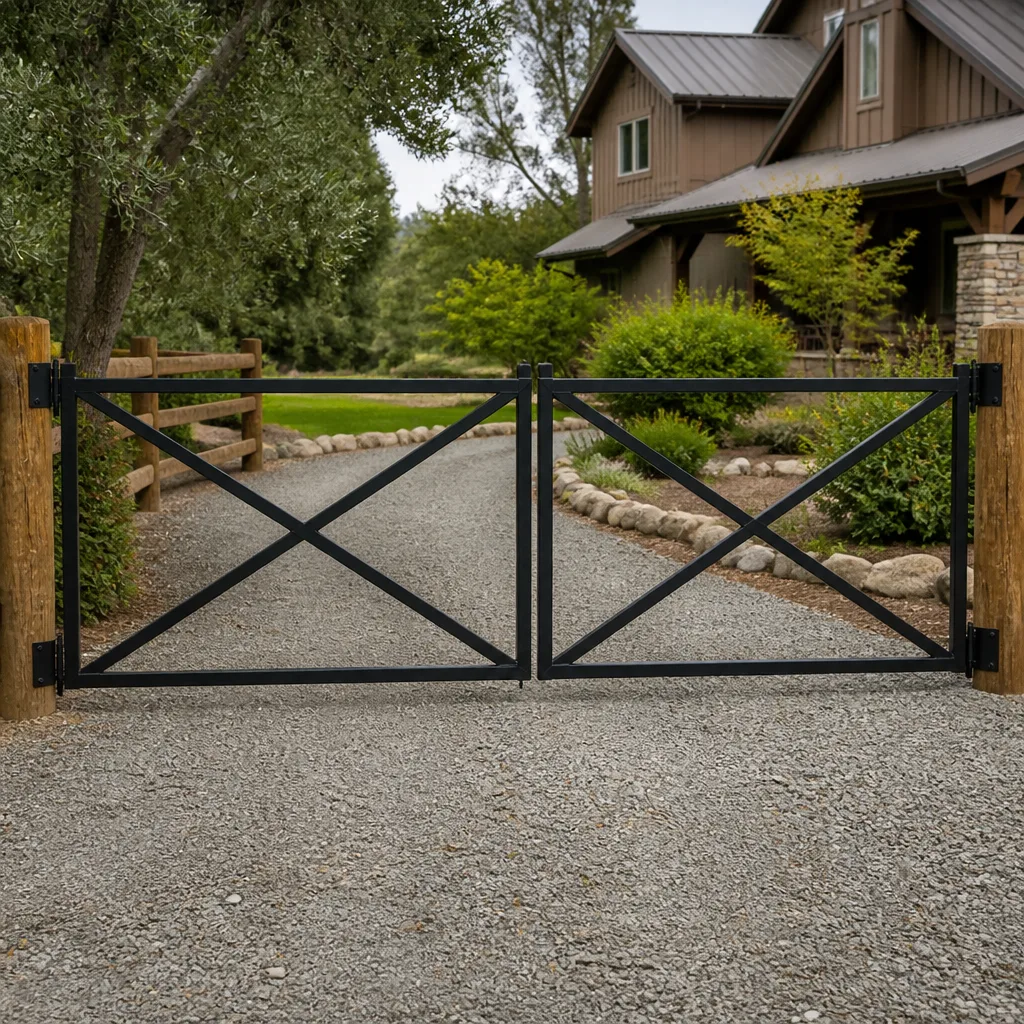 Farm & ranch
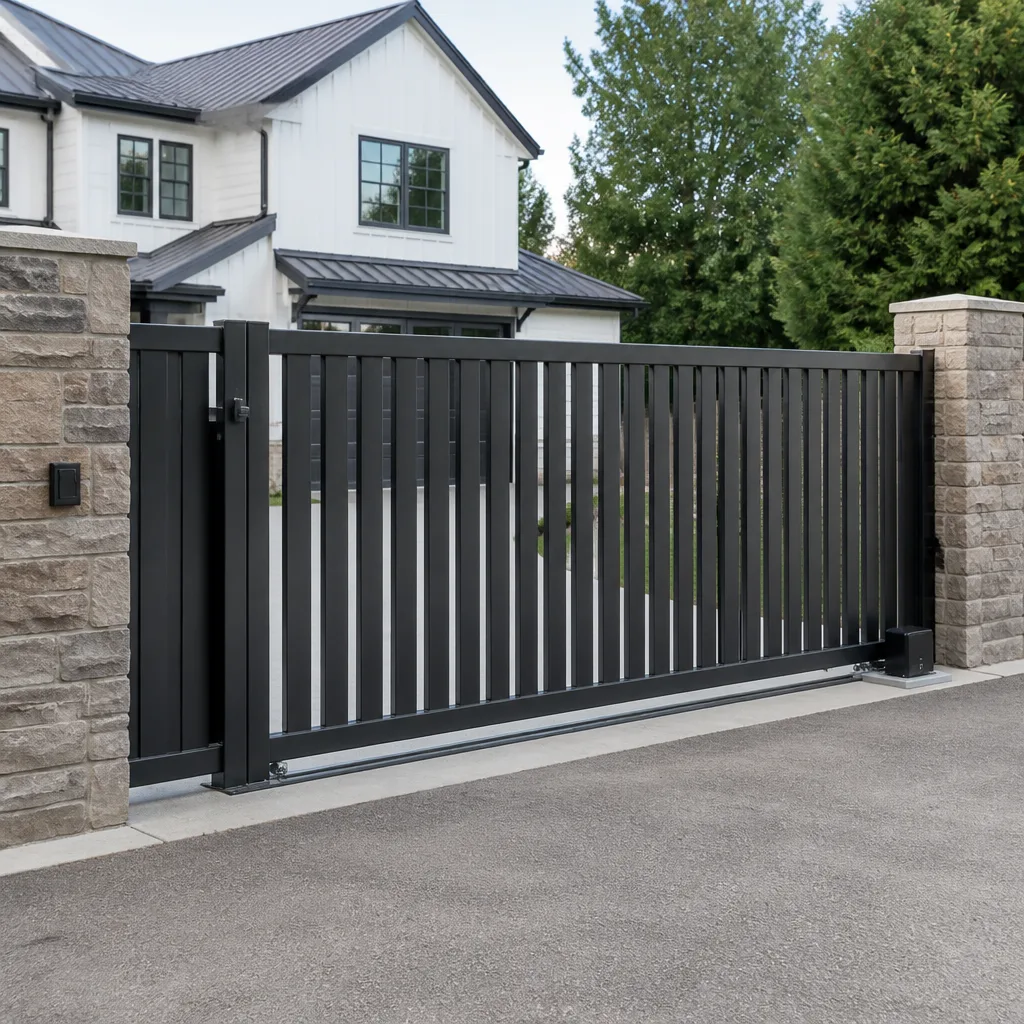 Sliding driveway gates
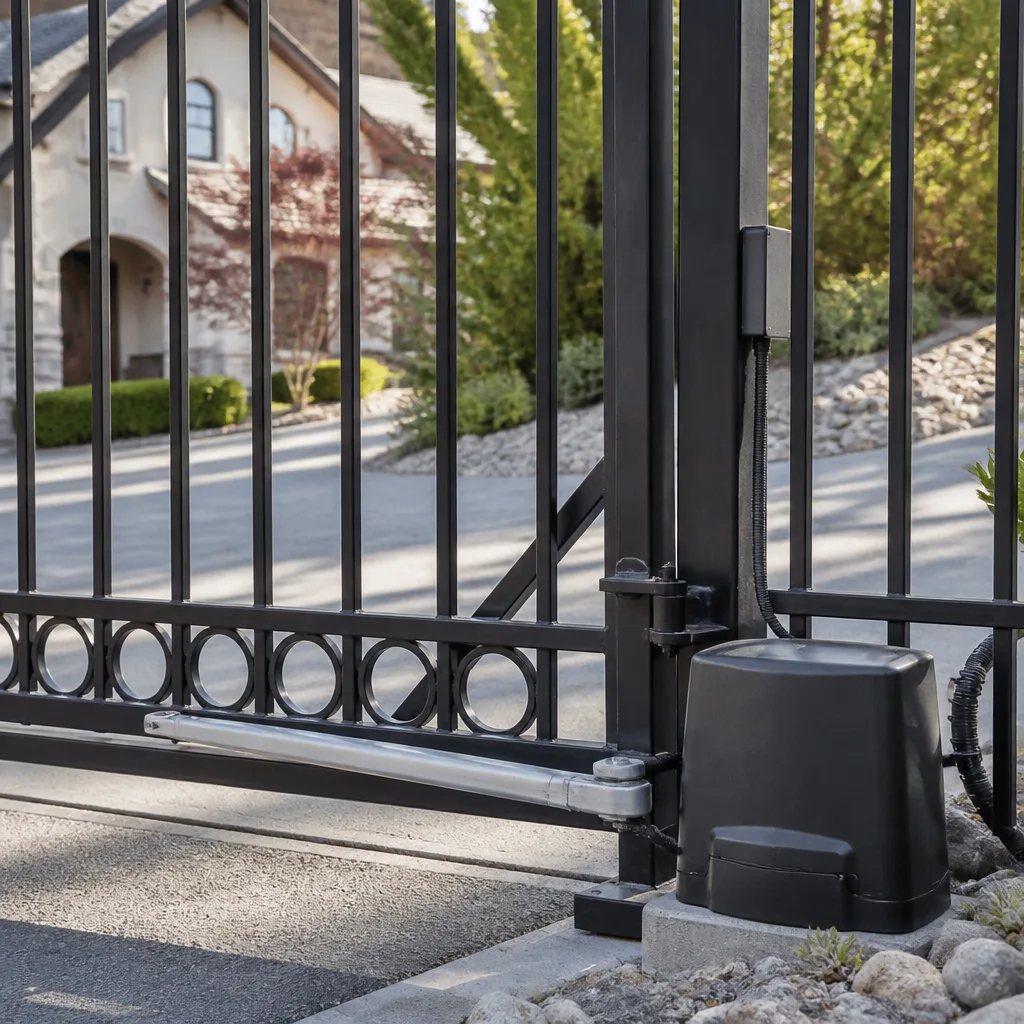 LiftMaster operators
Free on-site gate assessment - hinges, posts, and your LiftMaster or Nice gate operator checked before anything is quoted
The assessment is free and the quote is the invoice.
Get your free estimateThe Complete Guide to Gate Repair in Stockton
A gate that reverses, stalls, or beeps isn’t broken. It’s communicating a fault code most technicians never bother to read. The control board in an operator is a small computer, and it holds a record of exactly what went wrong and when. An opener that stops halfway isn’t telling you the motor died. It’s telling you a safety edge saw something, or a limit switch drifted, or a battery is sagging. When a technician skips the diagnostic readout and jumps straight to parts, you pay for guesses. This guide maps the full gate repair landscape in Stockton: how to tell operator trouble from mechanical trouble, why the Delta breeze and valley heat leave a distinct mark on local hardware, and when a fix lasts versus when it just buys you six months.
Quick Answer
Gate repair in Stockton comes down to three root causes: operator or control-board faults, mechanical wear on hinges, rollers and tracks, and power or access-control problems. A competent technician identifies which one is at play within the first ten minutes by reading the fault and testing each component in sequence. Most gate failures are repairable without replacing the whole system.
Styles & brands we work with
- Wrought iron
- Wood & steel frame
- Farm & ranch
- Sliding driveway gates
- LiftMaster operators
Table of Contents
- Operator Failure vs. Mechanical Failure: How to Tell the Difference
- Why Stockton’s Delta Breeze and Valley Heat Wear Gates Differently
- The Diagnostic Sequence a Real Specialist Uses
- Brand-Specific Quirks Across Common San Joaquin County Systems
- Permanent Fix vs. Temporary Patch
- Electric Gate Repair: Motors, Boards, and Access Control
- Manual Gates: What Actually Breaks
- When to Call a Professional
- Frequently Asked Questions
Operator Failure vs. Mechanical Failure: How to Tell the Difference
The fastest way to waste money on gate repair is to misread the symptom. An operator fault and a mechanical fault can look identical from thirty feet away, but they behave differently up close. Learning to separate them before you call anyone saves you from paying for a diagnosis you could have done yourself.
Here’s the split, in plain terms:
- Operator fault: The gate runs smoothly for a stretch, then stops or reverses with no obstruction. The motor hums but nothing moves. The beeping starts on its own. Remote and keypad stop responding at the same time. These point to the control board, the motor, the sensors, or power.
- Mechanical fault: The gate binds at the same spot every time. You hear grinding, scraping, or a groan. The gate sags or drags. It moves freely by hand in one direction and fights you in the other. These point to hinges, rollers, track alignment, or the gate leaf itself.
A quick field test: disconnect the operator (most have a manual release) and push the gate by hand. If it swings or slides freely, your problem is in the operator or controls. If it fights you or sticks, the mechanical side needs attention first. A misaligned gate will burn out a perfectly good motor over time, so fixing the operator without fixing the bind is a redo waiting to happen.
In Stockton, this distinction matters because valley heat stresses operators in ways that show up as intermittent faults. A board that’s marginal in cool weather can start faulting only in the afternoon. That’s not a mystery – that’s a component telling you it’s on its way out, and it’s exactly the kind of thing a proper diagnostic readout reveals before it becomes a total failure.
Why Stockton’s Delta Breeze and Valley Heat Wear Gates Differently
Stockton sits in the San Joaquin Valley where summer heat is intense and the afternoon Delta breeze rolls in off the water. That combination creates a specific wear pattern on exposed gate hardware that you don’t see in cooler or drier parts of California, and it’s worth understanding because it tells you where to look before something fails.
The heat does two things. It expands metal components and softens lubricants, so grease that works fine elsewhere migrates or thins out and hinges and rollers run dry. And it stresses the electronics inside an operator – control boards, capacitors, and batteries all run hotter than they were tested for, which shortens their life. The Delta breeze adds dust and airborne moisture that settle on exposed hardware and accelerate corrosion on painted steel, zinc-plated fasteners, and electrical connections. The pattern shows up first on the moving parts and the exposed terminals, not on the gate frame.
What this means in practice for a Stockton property:
- Check hinge pins, rollers, and the operator’s exposed wiring for corrosion and dryness more often than you would in a milder climate.
- Expect intermittent faults in summer that disappear in cooler months – treat them as a warning, not a fluke.
- Keep the control enclosure sealed and clear of debris; valley dust finds its way into anything open.
- Watch fasteners on gate posts and hinges for looseness as heat cycles loosen and re-seat metal.
None of this is about a special product or gimmick. It’s about knowing where the local climate bites so your inspection and your repair budget go to the right places.
The Diagnostic Sequence a Real Specialist Uses
The difference between a technician who fixes your gate and one who swaps parts until it works is a sequence. A specialist works through the system in order, ruling out causes one at a time. Guessing runs up your bill because each swap is a charge, and the real fault may still be there when the invoice lands.
Here’s the sequence we use, in order:
- Read the fault. Check the operator’s diagnostic indicator, error display, or board LEDs first. This narrows the field before a tool comes out.
- Test the mechanical side by hand. Release the operator and check that the gate moves freely. A bind or drag has to be corrected regardless of what the electronics say.
- Verify power and safety inputs. Confirm incoming voltage and check that safety edges, photocells, and loop detectors are reporting correctly. A phantom safety trip stops a gate as surely as a dead motor.
- Test the operator components. Check the motor, the control board, and the limits against the fault you read in step one.
- Test the access controls. Keypads, remotes, and receivers get checked last because they’re the least likely to cause an intermittent mechanical stall, and the easiest to blame wrongly.
- Confirm the fix under load. After the repair, cycle the gate several times and watch it, so a fix that only works once doesn’t leave as a callback.
The part-swap loop skips straight to step four or five. It replaces a receiver when the real problem is a worn roller, or a motor when the real problem is a control board. Reading the fault first and working in order is what turns a repair into a permanent fix instead of a recurring bill.
Brand-Specific Quirks Across Common San Joaquin County Systems
Every gate operator has its own personality. The same symptom – a gate that won’t close, a beep that won’t stop, a remote that quit – can have a completely different cause depending on the brand. This is why brand fluency matters more than general handiness, and why we keep fluency across nine major systems: LiftMaster, FAAC, BFT, Linear, Viking, Ghost Controls, DoorKing, Elite, and Mighty Mule.
A few examples of how the quirks differ across the systems you find on Stockton properties:
- LiftMaster operators put a lot of information in their diagnostic indicators, so a knowledgeable technician can read a fault straight from the unit. Their safety-reversing behavior is also specific, which rules out a lot of false leads fast.
- FAAC systems are common on heavier swing gates, and their limit and encoder behavior after a power interruption is a frequent cause of “it just stopped” calls. A re-learn or reset often resolves it – if you know the system.
- BFT operators have their own control-board logic and programming quirks, so an unfamiliar technician resetting the board can make things worse rather than better. Access to the right procedure matters.
- Linear systems show up widely on residential and light commercial gates, and their receiver and safety-input behavior explains many “dead remote” reports that have nothing to do with the remote.
The point isn’t that one brand is better than another. It’s that a technician who works only gates, every day, learns each system’s failure patterns and reads them correctly the first time. That’s the difference between diagnosing first and fixing right, and hoping a general repair works out.
Permanent Fix vs. Temporary Patch
Not every repair is created equal. Some fixes hold for years. Others keep the gate moving for a few months and then fail again, usually at the worst moment. Knowing which is which before you approve work keeps a repair from becoming a subscription.
A repair is a permanent fix when it addresses the root cause the diagnostic turned up. A control board replaced because the board itself failed, a worn roller replaced because the roller was worn, a sag corrected at the hinge that caused it – those hold. A patch is what happens when the symptom gets treated and the cause stays.
Common patches that cost more in the long run:
- Replacing a receiver when the remotes only “died” because a safety input was tripping the operator.
- Replacing a motor when the gate was binding, so the new motor is fighting the same drag and will fail the same way.
- Bypassing a safety edge or photocell to get the gate closing – this removes a protection the system was built with and puts the fault back in play.
- Greasing over a worn hinge or roller instead of replacing it, which quiets the symptom while the wear continues.
- Resetting a control board without reading why it faulted, which clears the code and leaves the cause untouched.
A specialist will tell you which kind of repair you’re getting and why. If a fix only holds until the next heat wave, that’s not a fix – it’s a delay, and you should know it up front.
Many property owners tell us they ended up searching for Gate Repair Stockton only after a patch failed a second time. The better move is to get the root cause diagnosed before that second failure.
Electric Gate Repair: Motors, Boards, and Access Control
Electric gates fail in a few predictable places, and knowing where they fail helps you describe the problem accurately and understand what a technician will do. The three main systems are the motor and drive, the control board that runs the logic, and the access system that tells the gate when to move.
The motor and drive carry the weight and the heat. When they fail, the gate stops moving on its own or moves slowly and noisily. The control board decides what the gate should do in response to limits, safety inputs, and commands, and when it fails you get intermittent behavior – random reversals, phantom stops, a gate that works one minute and not the next. Access control covers the keypad, receivers, remotes, and any loop or card system that told the gate to act.
Because these three systems interact, the fault can sit in any of them, and the symptoms overlap. A keypad that seems dead may be fine while a board input is the real problem. This is where electric gate repair earns its keep as a specialty. The diagnostics require reading the operator, testing the inputs, and understanding the system’s logic, not just checking for a loose wire.
Safety note: gate operators run on low-voltage control wiring and line-voltage power, and the wiring and power path are the genuinely dangerous part of this work. Heavy gate panels can crush, and a slide gate that leaves its track can injure someone or damage property. Those are jobs for a trained technician. If you smell burning at the control enclosure or see damaged wiring, keep people clear of the gate and don’t open the enclosure to investigate it yourself.
Manual Gates: What Actually Breaks
A manual gate is simpler, but it still fails, and it fails in ways that are worth knowing because they’re easy to overlook until the gate is stuck open. The parts that wear are the hinges, the rollers or track, the latch and latch post, and the gate frame itself.
Most manual gate problems trace back to movement that has drifted out of alignment. A gate that sags and drags on the ground, a slide gate that jumps its track, a latch that won’t catch because the post has shifted – all of these are alignment and wear issues rather than one dramatic failure. Left alone, they get worse because the gate keeps working against the bind, which grinds hinges and strains hinges and frame over time.
What to watch on a manual gate in Stockton:
- Hinges and rollers that squeak, bind, or show rust from the heat and airborne dust.
- A sagging gate leaf that drags the ground or rubs the fence.
- A latch that has to be lifted, forced, or held to close.
- A slide gate that jumps off its track or rolls roughly.
- Post movement at the base that throws everything downstream out of line.
Manual gate repair is often straightforward, but the diagnosis still matters. A latch that won’t catch because the post has moved won’t stay fixed if you straighten the latch and ignore the post. Fix the cause and the gate works, usually for a long time.
See the difference
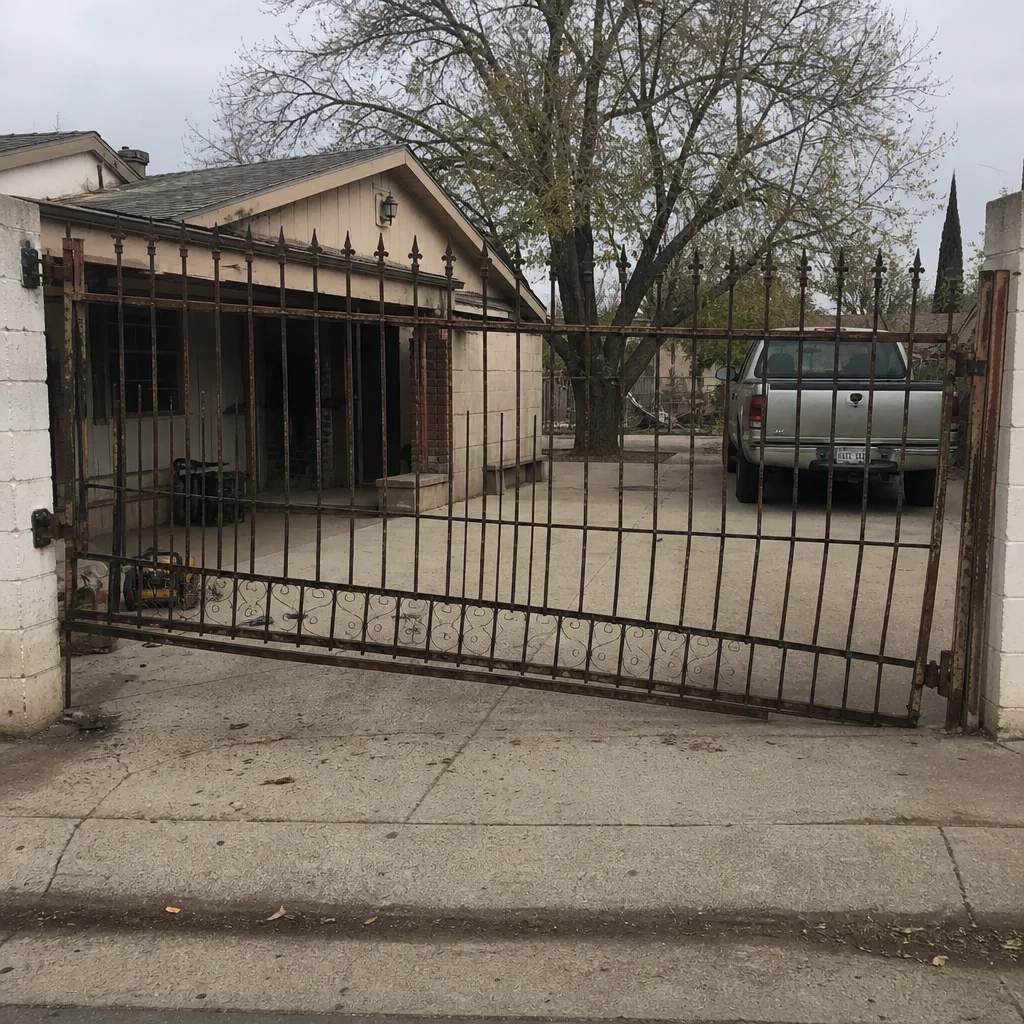 Before
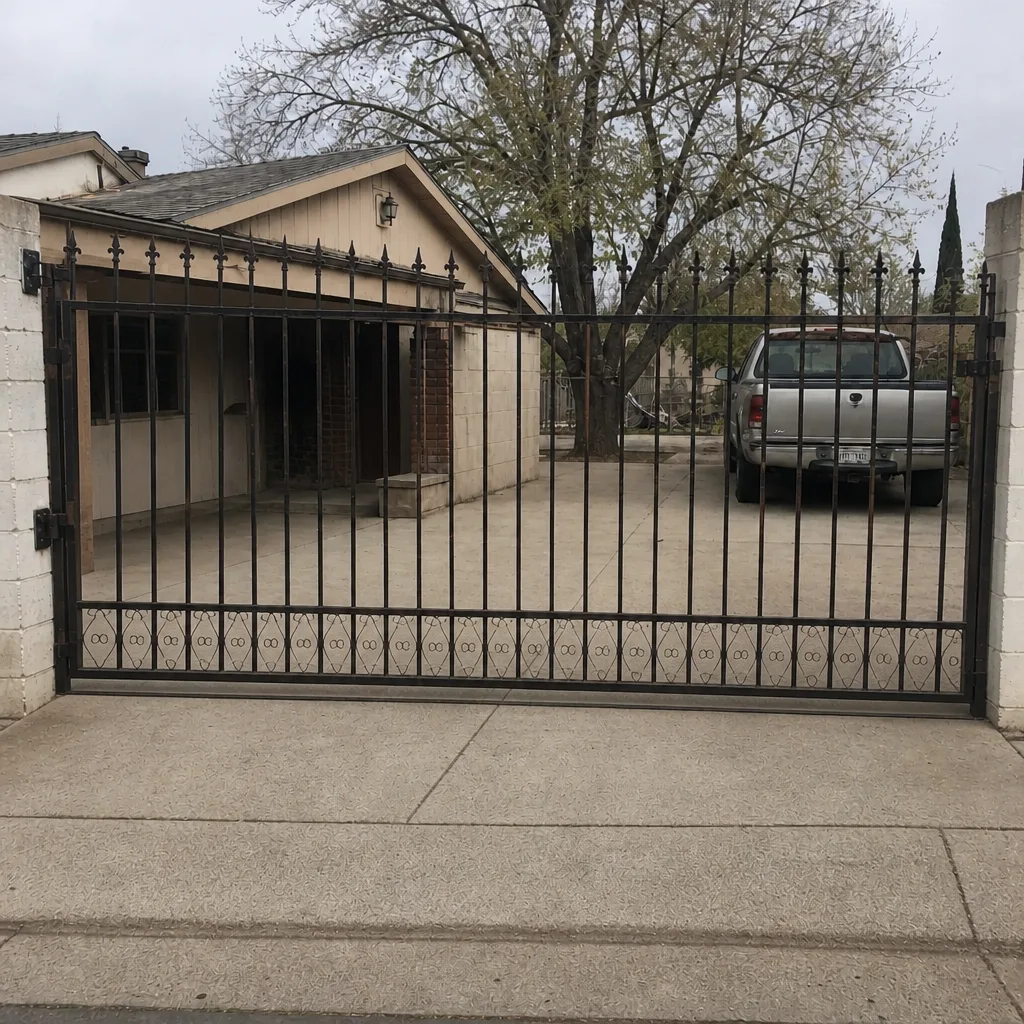 After
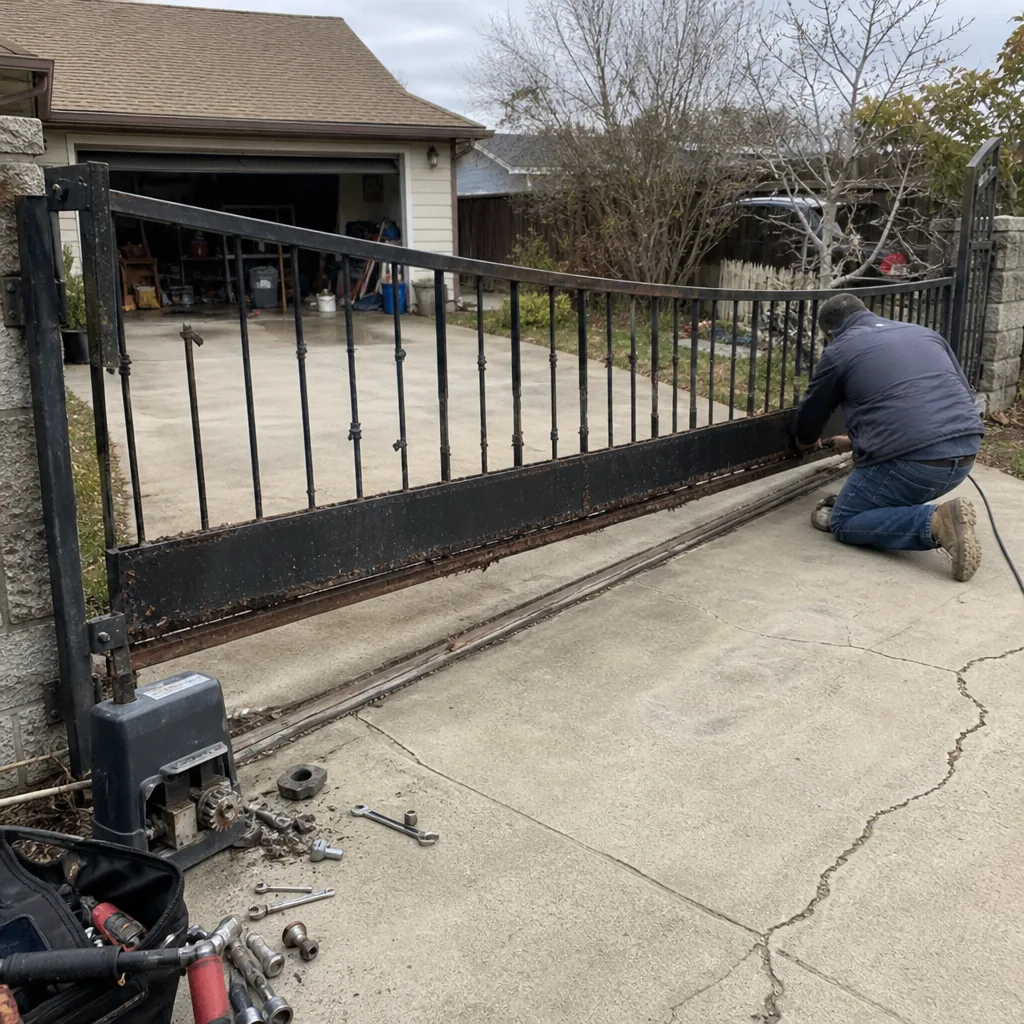 Before
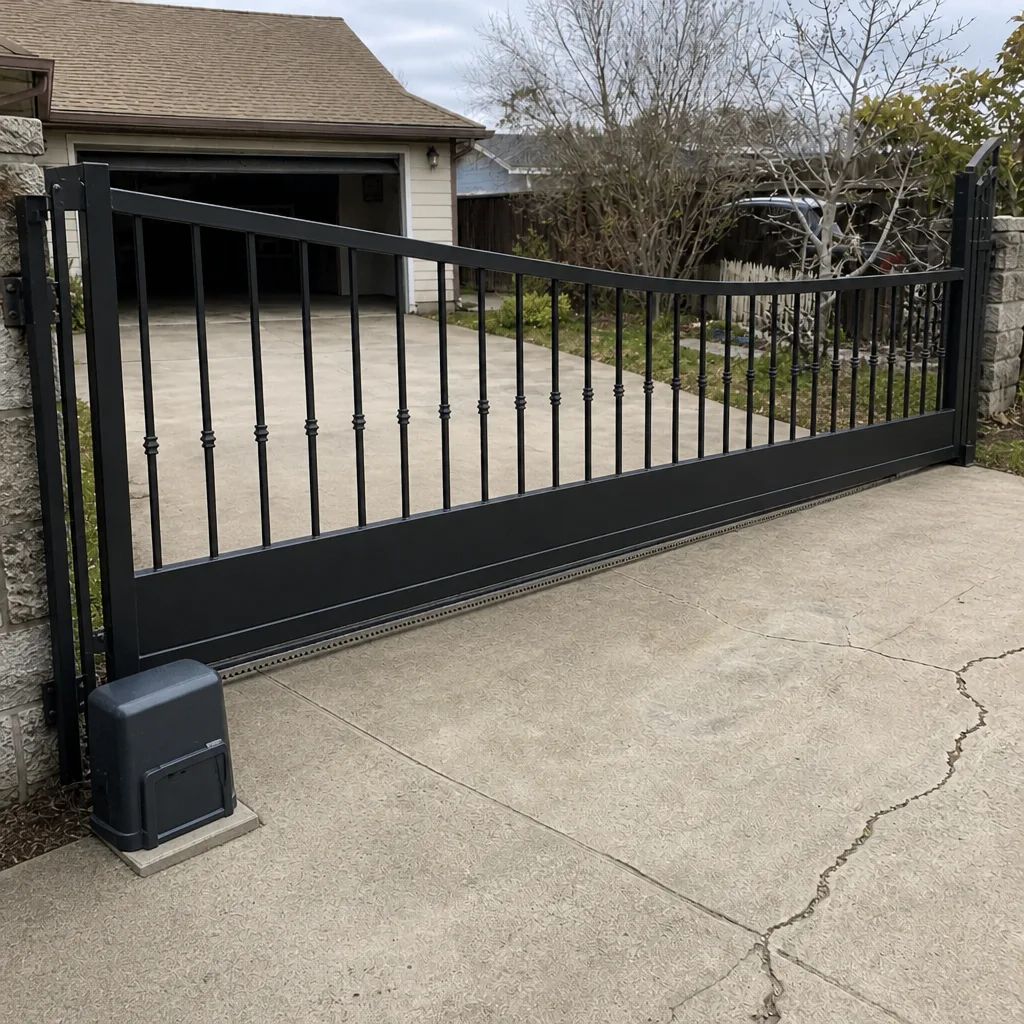 After
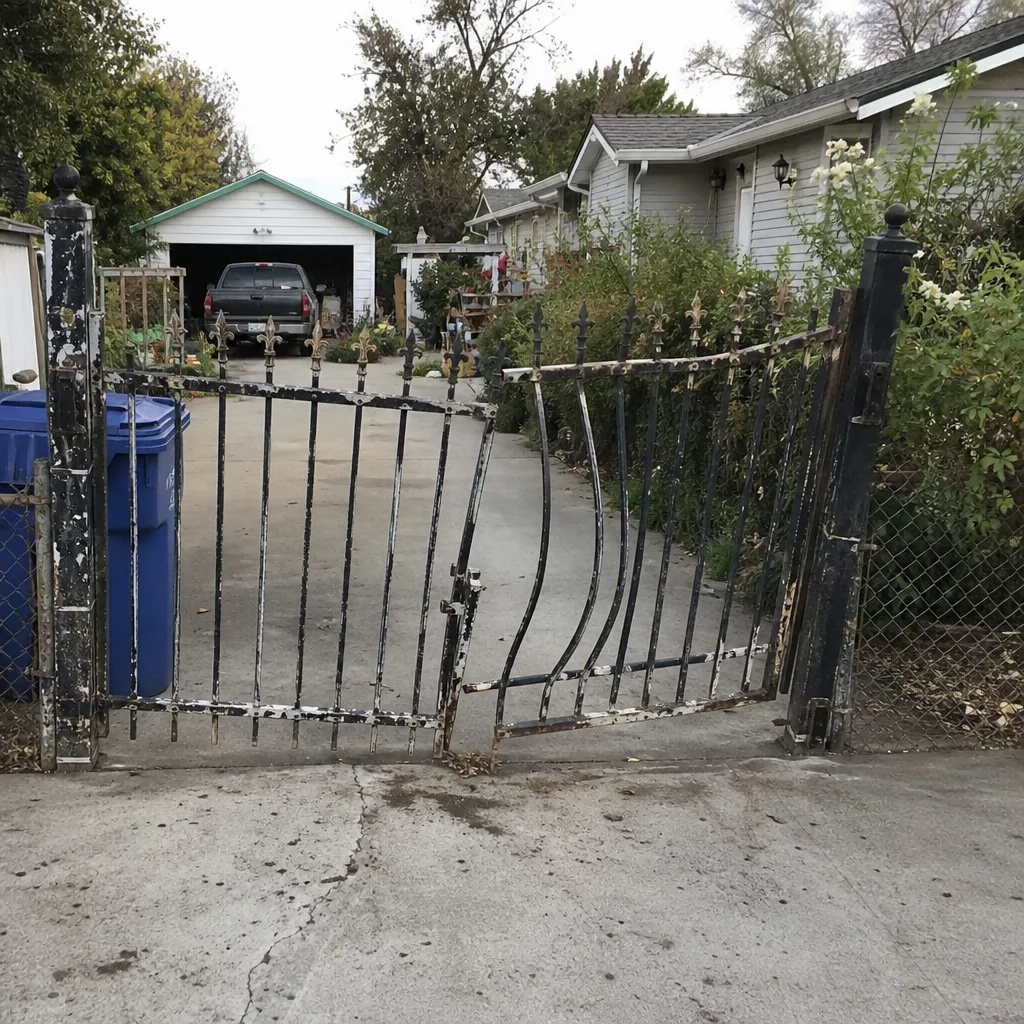 Before
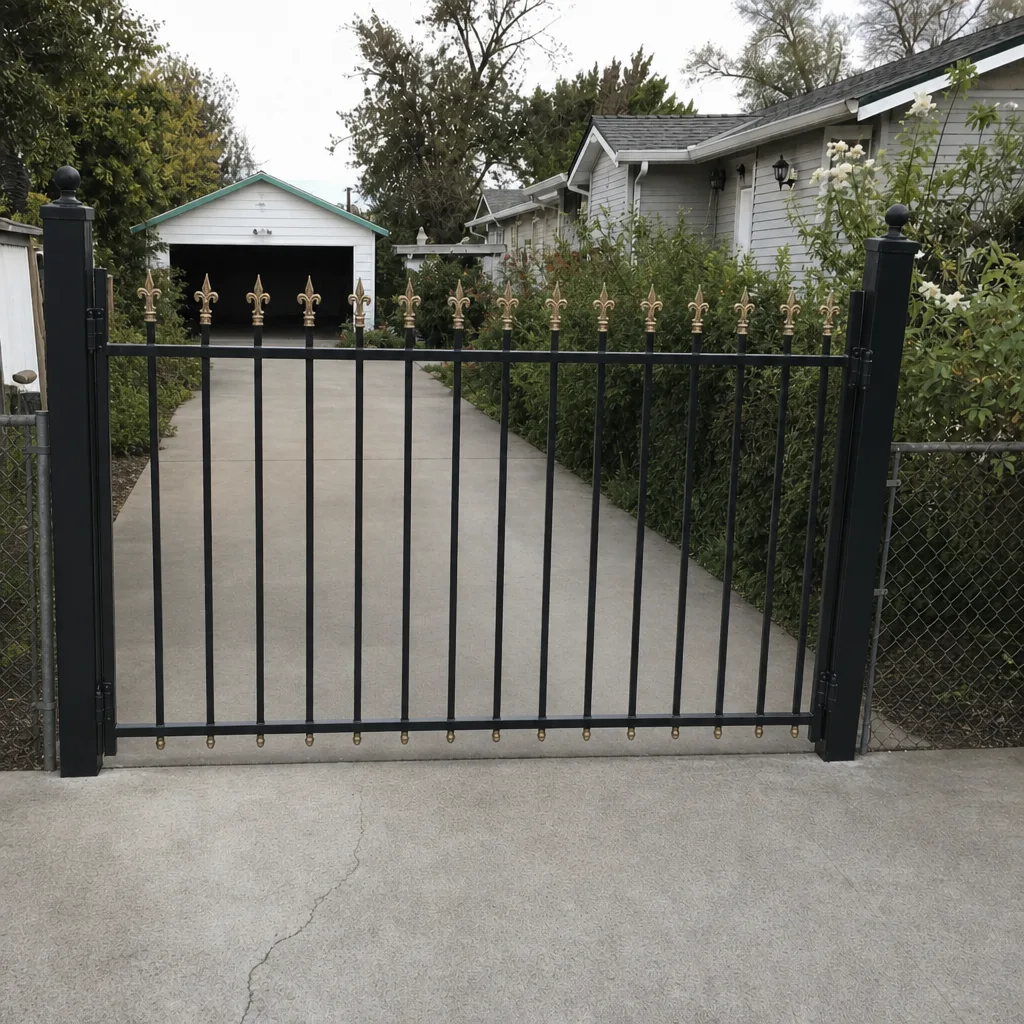 After
Common Mistakes to Avoid
- Bypassing safety devices to get the gate working. Photocells and safety edges exist to stop the gate from closing on a person, vehicle, or pet. Jumping them out to force the gate closed trades a repair for a hazard. Fix the fault correctly instead.
- Replacing the motor first. A binding gate or a bad sensor can make a healthy motor look dead. If the gate is dragging or a safety input is tripping, the motor may be the last thing that’s wrong, not the first.
- Ignoring an intermittent fault. A problem that shows up only in summer heat usually means a component is on its way out. Waiting for it to fail completely often means a bigger repair later.
- Greasing dried-out hardware instead of replacing it. Lubricant quiets a worn hinge or roller; it doesn’t rebuild one. Worn parts need replacing, and grease on the wrong parts just collects valley dust.
- Letting a repair stand in for a diagnosis. Any swap that isn’t backed by a fault read is a guess. If your technician can’t tell you what was wrong and how they confirmed it, you paid for a trial, not a fix.
- Assuming a handyman can handle a brand-specific operator. A board reset, programming sequence, or safety re-learn differs by system. A generalist guessing at a FAAC or Linear control board can leave the gate worse off than before.
When to Call a Professional
Call a specialist when the symptom points to the operator, the control board, or the access system, or when the gate has been patched once and failed again. Call sooner if the gate hangs open on a property that depends on it for security, if you see or smell anything wrong at the control enclosure, or if a slide gate has jumped its track or a gate leaf is dragging and could fall. Those are not wait-and-see problems. If the mechanical side is free and the operator is intermittent, you already know the electronics need a proper read. Gate Repair Stockton offers free estimates in Stockton – call (833) 946-1127. We answer 24/7, with fast dispatch from 7am to 7pm, Sunday through Friday.
Frequently Asked Questions
Often yes, for common faults like a dead remote, a stuck gate, or a control-board issue, once the fault is read. A call outside dispatch hours is booked into the next opening, Sunday through Friday, 7am to 7pm. The free estimate sets the price before any work starts.
Release the operator and move the gate by hand. If it moves freely, the fault is in the operator or controls. If it binds or drags, the mechanical side needs attention first. Fixing the operator without correcting a bind guarantees a repeat failure.
Likely yes. We’re fluent across LiftMaster, FAAC, BFT, Linear, Viking, Ghost Controls, DoorKing, Elite, and Mighty Mule, covering the most widely installed residential and commercial systems in San Joaquin County. You don’t need a brand-specific factory technician to get a proper diagnosis.
A beep before movement or a stop is usually a safety or limit signal, not a dead motor. The operator is warning of a condition the control board sees. Reading the fault tells you exactly which input it is. Call (833) 946-1127 for an exact quote, and the estimate is free.
It depends on whether the fault is a component or the gate itself. A worn board, motor, or sensor on a sound gate is usually worth fixing. A gate frame that’s failing while the operator is fine is a different question. The diagnostic answers it before you spend on either.
Yes. Electric gate repair covers the power path, the control wiring, and the safety edges and photocells that protect the gate. Keep people clear of a gate with damaged wiring or a bad safety edge until a technician looks at it. Contact us for a free estimate in Stockton.
The Bottom Line
Gate repair in Stockton rewards a sequence and punishes a guess. Read the fault, check the mechanical side by hand, verify power and safety inputs, and only then decide what to replace. The Delta breeze and valley heat make hinges, rollers, and electronics wear faster here, so intermittent faults deserve attention rather than patience. Whether your gate is manual or motorized, and whichever of the nine major systems it runs, the goal is the same: diagnose first, fix right. If a repair is a patch, you should be told so before you pay for it.
When your gate needs attention, gate repair is all we do, and we bring that focus to every call. Call (833) 946-1127 for a free estimate. We answer 24/7. Fast dispatch from 7am to 7pm, Sunday through Friday.
Written by the team at Gate Repair Stockton, serving Stockton since 2017.